
Ruby vs Diamond: Sparkle, Symbolism, and the Best Choice for Your Ring


Key Takeaways
- Rubies (red corundum) symbolize passion, courage, and royalty, while diamonds (pure carbon atoms) represent eternal love, strength, and unbreakable bonds—both carry powerful meaning for special occasions.
- Diamonds rank 10 on the Mohs scale, making them the hardest natural material and ideal for daily wear; rubies rank 9 and are highly durable but may show subtle wear over decades of constant use.
- Top unheated rubies with vivid red color are significantly rarer than most diamonds and can command a higher price per carat, though average diamonds typically cost more than average commercial rubies.
- Lab grown diamonds and lab created rubies offer ethical, affordable alternatives to natural ones, but for many couples, lab-created moissanite from Revarado delivers diamond-like brilliance, superior fire, and far better value than both.
- Choosing between these precious stones comes down to personal priorities: tradition vs. uniqueness, colorless sparkle vs. rich red color, and budget vs. rarity.
Ruby vs Diamond: What’s the Real Difference?
When shopping for an engagement ring or special piece of fine jewelry, couples often find themselves weighing two of the world’s most celebrated gems. Rubies and diamonds have captivated humanity for centuries, each offering distinct beauty and meaning. Understanding what sets them apart helps you make a confident, informed choice.
The chemical composition of these gemstones tells entirely different stories. Diamonds are formed from pure carbon atoms arranged in a rigid crystal lattice deep within the earth’s mantle under extreme heat and pressure. This structure creates their legendary hardness and incredible sparkle. Rubies belong to the corundum family—they’re aluminum oxide crystals with trace amounts of chromium, which produces their signature red coloration. The more chromium present, the deeper and more vivid red color the ruby displays.
The most obvious difference you’ll notice is visual. Most diamonds appear colorless or near-colorless, prized for their brilliant white and rainbow light performance. However, diamond colors can range from completely colorless to shades of yellow, brown, or even rare blues and pinks, with colorless diamonds being the most valuable and rare due to their purity. Rubies, on the other hand, are defined entirely by their color—ranging from soft pinkish-red to the highly prized pigeon blood red, a vivid red hue with slight blue undertones that collectors consider the pinnacle of ruby beauty.
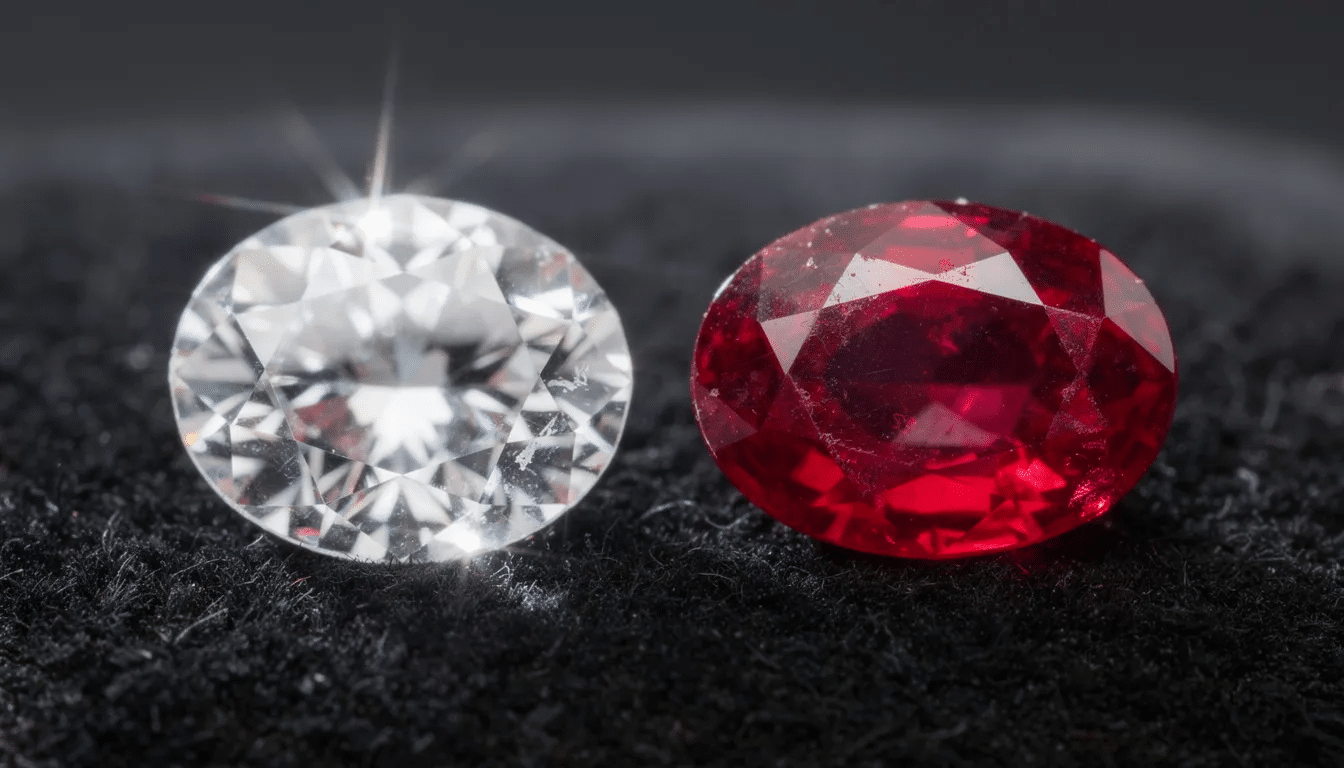
On the Mohs scale of mineral hardness, diamonds score a perfect 10—the maximum rating for any natural substance. Rubies come in at 9, which sounds close but actually represents about 40% less hardness. For a diamond ring worn every day, this means exceptional scratch resistance. A ruby engagement ring remains highly durable for everyday wear but is slightly softer and more prone to surface abrasion over many years of constant contact.
Cutting philosophies also differ between these gems. Diamond cuts are mathematically optimized to maximize brilliance—round brilliant, princess, oval, and emerald cut styles are all designed to bounce light in spectacular ways. Ruby cuts prioritize preserving the stone’s rich red color and carat weight, so you’ll often see oval, cushion, and pear shapes that may appear deeper or slightly less symmetrical than precisely calibrated diamond cuts. The cut styles of rubies are influenced by the ruby’s bright red hue, which affects how cutters approach depth and facet arrangement to best showcase the color.
Rubies differ from diamonds in clarity standards as well. While diamonds are valued for their lack of inclusions, rubies often contain unique inclusions such as needles, crystals, or silk, which can either enhance or detract from their value depending on their visibility and pattern. These differences influence both the appearance and valuation of the gemstones.
Origin, History, and Symbolism
For thousands of years, both rubies and diamonds have adorned the crowns and treasuries of kings, queens, and emperors. Their enduring appeal speaks to something universal about human desire for beauty and meaning.
Diamond mining traces back over 2,000 years to ancient India, where these precious stones were first discovered in riverbeds and valued for their mystical properties. The 19th and 20th centuries brought major discoveries in Africa and Russia, dramatically increasing supply. By the mid-1900s, clever marketing transformed diamonds into the undisputed symbol of engagement—a tradition that persists today.
Rubies carry equally royal heritage. The finest specimens historically came from Myanmar’s legendary Mogok Valley, and in Sanskrit, rubies earned the title “ratnaraj”—king of gems. Asian and European royalty alike incorporated rubies into crowns, scepters, and ceremonial jewelry. The Sunrise Ruby, a Burmese stone weighing just over 25 carats, sold for over $30 million, illustrating just how incredibly valuable top specimens can become. ‘Pigeon’s blood’ rubies, known for their vivid red color and rarity, are highly valued by collectors and connoisseurs, making them some of the most sought-after gemstones in the world.
The symbolism attached to each stone shapes how couples choose them. Diamonds have become emblems of everlasting love, clarity of commitment, and enduring love—they’re the April birthstone and traditional gift for 60th wedding anniversaries. Their timeless elegance makes them the default for minimalist, classic luxury.
Rubies carry passion, courage, and vitality in their deep red hue. As the July birthstone, they appeal to those born in summer and anyone drawn to bold, romantic statements. Ruby’s bright red hue evokes vintage glamour, Art Deco sophistication, and heirloom-quality designs that stand apart from conventional choices.
Rarity and Price: Is Ruby More Expensive Than Diamond?
“Which costs more in 2025?” It’s the question everyone asks—and the honest answer is that it depends entirely on quality, size, and origin.
Here’s what makes pricing complicated: gem-quality natural rubies with vivid saturation and minimal inclusions are geologically significantly rarer than commercial-grade diamonds, especially those over one carat. Finding a clean, richly colored ruby of substantial size is genuinely difficult, which drives prices for top specimens into stratospheric territory.
Consider realistic numbers. A fine one carat ruby—unheated, from Myanmar or Mozambique, with saturated color—can easily exceed the per carat price of many G-H color, VS-SI clarity diamonds of the same carat weight. Untreated rubies from prestigious origins command premiums that make high quality rubies extremely rare finds in the market.
However, for typical jewelry shoppers, the picture often reverses. A standard one carat diamond of engagement quality (say, G-I color, VS2-SI1 clarity) will usually cost more than a comparable-size commercial ruby of standard quality. The carat price gap between exceptional and ordinary stones is simply more dramatic for rubies than for most diamonds.
Market structure matters too. Diamond prices follow standardized grading systems (the 4Cs) and benchmark pricing lists, making comparison relatively straightforward. Ruby pricing is far more variable, driven heavily by color grading, geographic origin, and treatment status. Two rubies of identical size can differ in price by 10x or more based on these factors.
Here’s where modern alternatives change the conversation: lab-created diamonds and lab created rubies cost significantly less than their natural counterparts while offering nearly identical visual properties. And moissanite from brands like Revarado undercuts both while delivering even more fire and brilliance—an attractive option for couples prioritizing value without sacrificing beauty.
Beauty Factors: Color, Clarity, Cut, and Carat
Understanding how jewelers evaluate these valuable stones helps you shop with confidence. Here’s how to “read” rubies and diamonds like a professional, without drowning in jargon. Color, clarity, cut, and carat are the key factors that influence gemstone value and selection.
Color works completely differently for each gem. Diamond color grading runs from D (perfectly colorless) through Z (light yellow or brown tints), with D-F considered the most valuable. Fancy colored diamonds—including extremely rare red diamonds—exist outside this scale and command extraordinary premiums. Rubies, by contrast, are judged on three dimensions: hue (the primary red color, ideally with slight blue rather than orange undertones), tone (medium to medium-dark is most desirable), and saturation (the intensity of color, with “pigeon blood” vivid saturation representing the peak). When ruby tone becomes too light, stones may be reclassified as pink sapphires rather than true rubies.
Clarity describes internal characteristics. Diamond clarity grades range from Flawless (no inclusions visible under 10x magnification) down to Included (visible to the naked eye). Many buyers find that SI-grade diamonds appear perfectly clean to unaided vision. Most rubies contain inclusions—this is expected and accepted. Some “silk” (fine needle-like inclusions) actually enhances a ruby’s visual softness and distributes color attractively, so perfect clarity isn’t always desirable.
Cut quality determines how light performs within each stone. High quality diamonds are cut to precise mathematical specifications—round brilliant, oval, cushion, or emerald cut—optimized for maximum sparkle and fire. Because ruby’s bright red hue naturally muffles light refraction effects, cutters prioritize color retention and weight preservation over ideal proportions. Natural rubies may appear slightly asymmetrical or deeper-cut compared to calibrated diamond cuts.
Carat weight indicates size, but density differences matter. Rubies have higher specific gravity than diamonds, meaning a ruby of the same carat weight will face up slightly smaller than an equivalent diamond. Price jumps sharply at “magic sizes”—1.00, 1.50, and 2.00 carats—for both gems, as market psychology favors these round numbers.
Durability and Daily Wear: Which Lasts Longer?
Beyond sparkle and symbolism, couples planning engagement or wedding jewelry need to consider practical longevity. Will your ring withstand daily wear for decades?
Diamond’s position at 10 on the Mohs scale makes it the hardest natural material on Earth. This exceptional hardness translates to remarkable scratch resistance—your white diamond or colored diamond will resist abrasion from virtually any household material. However, hardness doesn’t equal invincibility. Diamonds have cleavage planes in their crystal structure, meaning a sharp impact at the wrong angle can cause chipping.
Rubies at Mohs 9 are still among the hardest substances available and are absolutely suitable for daily wear. High quality rubies set in protective settings can last generations. That said, over decades of constant contact—think keyboard typing, door handles, countertops—rubies are slightly more likely to show microscopic surface wear than diamonds. The difference is subtle and accumulates slowly, but it exists.
Both gems benefit from regular gentle cleaning with mild soap and warm water. Avoid harsh chemicals and ultrasonic cleaners for treated rubies, particularly those with surface-reaching fractures or residue-filled inclusions that could be damaged by heat or vibration.
Practical guidance for your decision:
- For maximum durability with minimal maintenance, choose diamonds or diamond-like moissanite for rings you’ll never remove.
- If you love rubies, consider protective settings like bezels or halos that shield vulnerable edges and corners.
- Very active wearers—those working with their hands, exercising heavily, or frequently outdoors—may find diamonds or moissanite more forgiving over time.
Natural vs Lab-Created: Rubies, Diamonds, and Ethical Alternatives
Technology has fundamentally reshaped the gemstone market since around 2010. Lab-grown stones have moved from novelty to mainstream, offering ethical and affordable paths to beautiful jewelry.
Lab-created diamonds are produced using two primary methods: HPHT (High Pressure, High Temperature) and CVD (Chemical Vapor Deposition). Both processes recreate the conditions that form natural diamonds, resulting in stones with identical physical, chemical, and optical properties. The only difference is origin—and price. Lab diamonds typically cost 30-60% less than comparable mined specimens, making larger, higher-clarity stones accessible to more buyers.
Lab-created rubies are grown using flame-fusion or flux methods, producing stones with consistent color and exceptional clarity—often cleaner than natural ones would ever be. These gems cost a fraction of fine natural rubies while delivering the same deep red hue that makes rubies so beloved. For buyers who love color but can’t justify the high cost of premium natural specimens, lab rubies offer an excellent compromise.
The ethics question increasingly influences purchasing decisions. Traditional diamond mining has documented environmental impacts and labor concerns in certain regions. Colored gemstone mining faces similar challenges. Lab-grown options sidestep these issues entirely, providing traceable origins and sustainable production.

Revarado specializes in lab-created moissanite jewelry, positioning ourselves as the diamond alternative that doesn’t compromise on brilliance. Moissanite ranks 9.25-9.5 on the Mohs scale—harder than rubies—and displays even more fire (those colorful flashes of light) than diamonds due to its higher refractive index. It’s fully lab-grown, ethically sourced, and costs substantially less than either natural diamonds or natural rubies of comparable size.
Choosing for Engagement Rings and Fine Jewelry
Shopping for a 2025 or 2026 engagement ring? Here’s how to match your gemstone choice to your vision and lifestyle.
Diamonds for engagement remain the cultural standard—timeless, universally recognized, and infinitely versatile. A colorless diamond pairs seamlessly with any metal (yellow gold, rose gold, white gold, platinum) and any outfit. Their superior hardness makes them ideal for rings worn 24/7. Many modern couples choose lab diamonds or moissanite to maximize size and quality within their budget, particularly those prioritizing visual impact over tradition.
Rubies for engagement make bold, romantic statements. They appeal to those who treasure uniqueness, vintage-inspired aesthetics, or meaningful July birthstone connections. A ruby engagement ring stands out in any crowd, conveying passion and individuality. Rubies pair especially beautifully with yellow gold and rose gold, though they look equally striking in white metal settings for high-contrast drama.
Combined designs offer the best of both worlds. Consider rubies as center stones surrounded by diamond or moissanite halos for added sparkle, or diamonds/moissanite centers with ruby side stones for personalized color symbolism. Three-stone rings can incorporate both gems to represent past, present, and future with visual variety.
Practical tips for your decision:
- Match stone choice to lifestyle—hands-on professions favor harder stones; desk jobs allow more flexibility
- Consider personal style—minimalist tastes often prefer colorless brilliance; maximalist personalities embrace color
- Think about long-term care expectations—rubies require slightly more attention than diamonds
For those exploring diamond alternatives, Revarado’s moissanite engagement ring collections deliver maximum sparkle, ethical peace of mind, and impressive stone sizes within typical engagement budgets.
Gemstone Settings and Accents: Enhancing Your Stone’s Brilliance
The setting you choose for your engagement ring or fine jewelry can dramatically influence how your gemstone looks and feels. For diamonds, a classic solitaire setting lets the stone’s incredible sparkle take center stage, especially when paired with the clean lines of white gold or platinum. If you’re drawn to the rich, vivid red color of a ruby, a halo setting—where smaller diamonds or colored diamonds encircle the center stone—can amplify the ruby’s deep red hue and create a striking contrast.
Metal choice is another key factor. A ruby engagement ring set in yellow gold brings out the warmth and intensity of the ruby’s color, while rose gold adds a romantic, vintage-inspired touch that flatters both rubies and diamonds. White gold, on the other hand, offers a modern, crisp backdrop that makes both rubies and diamonds pop, especially in designs that feature both gemstones together.
Accents can elevate your ring’s design even further. Adding colored diamonds or other precious stones as side stones or in a pavé band introduces extra sparkle and sophistication. Whether you prefer a minimalist look or a more ornate style, the right combination of setting, metal, and accents will ensure your gemstone—be it a diamond, ruby, or a mix of both—truly shines and reflects your personal taste.
Ruby vs Diamond vs Moissanite: Where Revarado Fits In
If you’re torn between tradition, color, and value, understanding how these three options compare helps clarify your path forward.
Sparkle and light performance differ meaningfully. Diamonds offer intense white brilliance and the rainbow fire effect that’s captivated generations. Rubies deliver a rich, luminous glow—their color takes center stage rather than diffusing light into spectral flashes. Moissanite produces the most dramatic fire of all three, with colored light flashes that often surpass even high-quality diamonds, creating incredible sparkle in natural lighting conditions.
Pricing in practical terms reveals interesting trade-offs. Consider a typical engagement budget around $2,000-$3,000. That range might buy:
- A modest natural diamond (perhaps 0.5-0.7 carats, G-I color, SI clarity)
- A larger, higher-quality lab diamond (0.8-1.2 carats, D-F color, VS clarity)
- A vivid lab ruby of 1+ carats with excellent color
- A premium moissanite from Revarado in 1.5-2+ carats with exceptional brilliance
The value proposition shifts dramatically depending on which qualities matter most to you.
Ethics and sustainability align well with all lab-created options. Both lab rubies and lab diamonds eliminate mining concerns, but Revarado’s moissanite is specifically grown in controlled laboratory environments with full traceability—a perfect fit for eco-conscious and ethically minded couples.
Our position is straightforward: Revarado’s moissanite rings are ideal for those wanting diamond-level brilliance and durability for everyday wear without the diamond price tag or mining concerns. If colored accents speak to you, rubies or sapphires can complement moissanite centers beautifully, adding personal symbolism to your design.
Trends and Popularity: What’s Hot in Modern Jewelry
Modern jewelry trends are all about self-expression and individuality, and this is especially true for engagement rings. More couples are moving beyond the traditional diamond ring, exploring the allure of fancy colored diamonds and the bold statement of a ruby engagement ring. High quality rubies, particularly those with exceptional clarity and a vivid red hue, are in high demand for their rarity and unique beauty.
Lab created rubies and diamonds have also surged in popularity, offering an ethical and budget-friendly alternative to natural stones without compromising on brilliance or color. Social media platforms have played a big role in shaping these trends, with influencers and celebrities showcasing custom designs that feature colored diamonds, rubies, and other gemstones in creative settings.
Whether you’re drawn to the timeless elegance of a diamond ring or the vibrant personality of a ruby engagement ring, today’s market offers more options than ever. The focus is on quality—particularly those stones with outstanding cut, color, and clarity—and on finding a piece that feels as unique as your own love story.
Gifting and Pairing: Making the Perfect Choice for Every Occasion
Choosing the right gemstone for a special occasion is all about personalization. A ruby engagement ring is a passionate and meaningful choice for a proposal, symbolizing love and vitality. For anniversaries or milestone birthdays, a classic diamond ring or a pair of diamond earrings can be a timeless and elegant gift.
Rubies and diamonds also pair beautifully together, creating jewelry that’s both eye-catching and symbolic. Consider a necklace featuring alternating rubies and diamonds, or a diamond ring with a ruby accent for a pop of color. Birthstones add another layer of meaning—ruby for July and diamond for April—making your gift even more thoughtful and personal.
By considering the recipient’s style, favorite colors, and the significance of the occasion, you can select gemstones that not only dazzle but also carry deep personal meaning. Whether you’re celebrating a romantic milestone or simply want to show someone you care, rubies and diamonds are gemstones that make every moment unforgettable.
How to Decide: A Simple Step-by-Step Guide
Ready to make your choice? This practical checklist walks you through the decision process with clarity.
Step 1 – Define your priorities. Rank what matters most:
- Color vs. colorless sparkle
- Tradition vs. uniqueness
- Ethical sourcing concerns
- Budget flexibility
- Daily wearability requirements
Step 2 – Set a firm budget. Decide on a comfortable total spend that includes the center stone, setting, and any matching wedding band. Knowing your limit prevents emotional overspending.
Step 3 – Choose your stone category:
- Natural diamond – Best for tradition-focused buyers wanting classic prestige and maximum hardness
- Lab diamond – Best for those wanting diamond properties with better value and ethical sourcing
- Natural ruby – Best for collectors, those with July birthdays, or vintage jewelry enthusiasts willing to invest heavily
- Lab ruby – Best for ruby lovers seeking color without the high cost of premium natural specimens
- Lab-created moissanite (Revarado) – Best for maximum sparkle, excellent durability, ethical origins, and outstanding value
Step 4 – Pick metal and style. Match your stone to complementary settings:
- Rubies pair warmly with yellow gold and rose gold
- Diamonds and moissanite look particularly crisp in white gold or platinum
- Popular styles include solitaire (timeless elegance), halo (maximum sparkle), three-stone (symbolic meaning), and vintage-inspired (romantic character)
Step 5 – Confirm durability and care requirements. Ensure your chosen stone and setting match the wearer’s lifestyle. Ask about care instructions and warranty details when ordering, especially from online retailers.

Professional Analysis and Certification: Ensuring Authenticity and Value
When investing in precious gemstones like rubies and diamonds, professional analysis and certification are essential for peace of mind. A reputable gemological laboratory, such as the Gemological Institute of America (GIA), will provide a detailed report evaluating your gemstone’s carat weight, color, clarity, and cut. This certification not only confirms the authenticity of your precious gemstone but also helps establish its rarity and value—especially important for high quality rubies and diamonds.
A professional report will also disclose any treatments or enhancements, such as heat treatment for rubies or HPHT for diamonds, ensuring full transparency about your gemstone’s history. For collectors and buyers alike, certification is a safeguard that protects your investment and guarantees you’re getting exactly what you pay for.
Whether you’re purchasing a one carat diamond, a rare ruby, or any other valuable stone, always request a certificate from a trusted authority. This step ensures your gemstone’s quality, authenticity, and long-term value, making your jewelry purchase a truly wise and lasting investment.
FAQ
Is a ruby engagement ring as durable as a diamond ring for everyday wear?
Rubies rank 9 on the Mohs scale, making them among the hardest colored gemstones available. When set securely in protective settings and treated with reasonable care, a ruby engagement ring can absolutely withstand daily wear for decades. However, diamonds at Mohs 10 resist scratches even more effectively, typically maintaining their “new” appearance longer under heavy, constant use. Very active wearers might consider bezels or halos for rubies, or opt for moissanite or diamond as their primary everyday stone.
Are rubies a good investment compared to diamonds?
Top-quality untreated rubies from renowned origins—particularly those displaying pigeon blood red coloration—can be extremely collectible and sometimes more valuable per carat than many diamonds of comparable size. However, for typical retail buyers, both ruby and diamond jewelry should be viewed primarily as sentimental and aesthetic purchases rather than guaranteed financial investments. Lab-created stones and moissanite, like Revarado’s offerings, are chosen specifically for beauty and ethics rather than resale value.
How can I tell if a ruby or diamond is lab-grown or natural?
Always request professional documentation. Grading reports from reputable laboratories (like GIA) clearly state whether a stone is natural or laboratory-grown, along with any treatments applied. Visual identification alone is unreliable—modern lab-grown gems closely replicate natural growth patterns and inclusions that even trained eyes can struggle to distinguish without equipment. Purchase from transparent brands and retailers who clearly disclose origin, treatment status, and quality grades.
Which metal looks best with rubies and which with diamonds or moissanite?
Rubies pair beautifully with yellow gold and rose gold for a warm, regal aesthetic that complements their red tones. They also look stunning in white metals for modern, high-contrast drama. Diamonds and moissanite typically appear brightest and whitest in white gold and platinum settings, though many people love their softer appearance against yellow or rose gold. Consider your skin tone, existing jewelry collection, and everyday wardrobe when making this choice.
Does Revarado sell ruby or diamond jewelry, or only moissanite?
Revarado focuses on lab-created moissanite as our primary center stone material, designed to deliver a high-sparkle, ethical alternative to mined diamonds. Our collections emphasize engagement rings, wedding bands, and fine jewelry that provide diamond-like brilliance with superior fire at a more accessible price point. Ready to explore your options? Browse Revarado’s moissanite engagement ring collections online to find the perfect expression of your enduring love story.